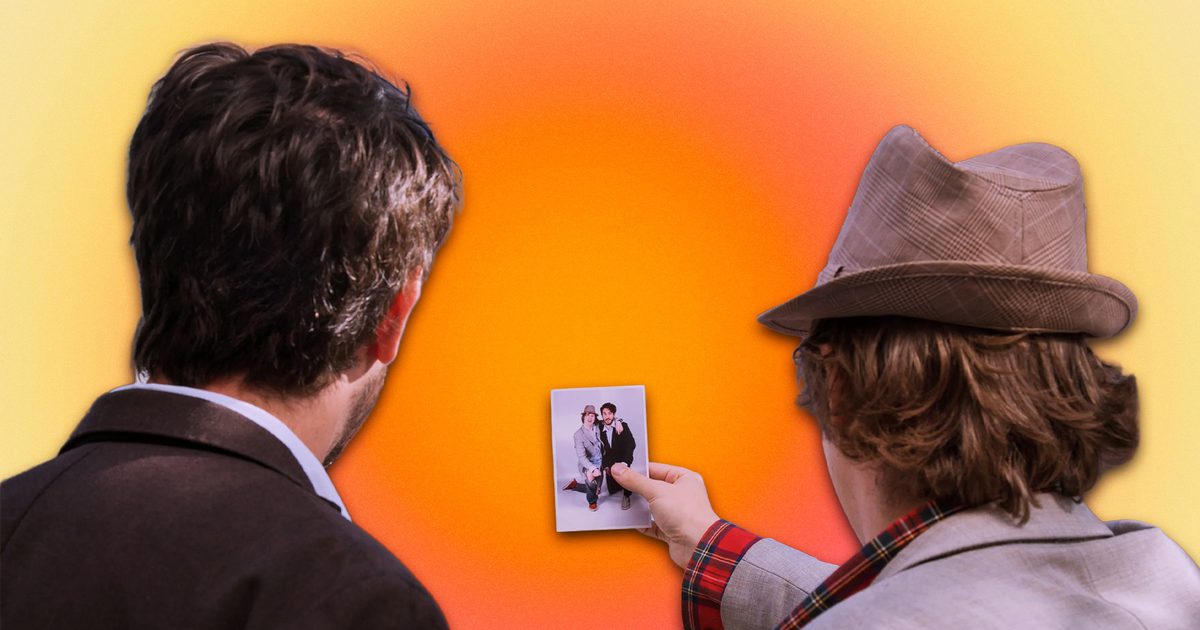

Repetition is apart of this theatre of the absurd. As “Matt and Jay try to get ashow at The Rivoli…” appears at the start of almost every episode, the series is defined by increasingly complicated schemes to try to secure agig; displaying an accidentally explicit banner of the band opposite the venue, various heists and break-ins, and even kidnapping asick child in the hope of hijacking their Make-A-Wish request. No lessons are learned from their schemes or mistakes, just as ultimately no progress is made. This cycle of continual, hopeless stasis in spite of continuous dreaming, scheming and loitering sees ‘Waiting for Godot’ turned into Waiting for aShow.
Unlike other shows where amooted or desired movie never came to fruition – or, likeCommunity, are long-running gags and sources of speculation – there has always been adogged sense of forward motion of the real-life Nirvanna The Band, even amidst periods of hiatus. This can be seen in the growing ambitions of the evolution of the work, which always seemed to be looking ahead, running in parallel with the ambitions of its creators. Taking the opening credits as an example, those of the web series predominantly referenced television shows includingFrasier andThe Wire. Moving to television, the reference points moved to cinematic touchpoints includingHome Alone,My Dinner with Andre andDog Day Afternoon.
The duo’s world grows too. The original apartment and its recurring gag of acopy of1993’sDragon: The Bruce Lee Story becomes ahouse wallpapered with Criterion Collection posters and decorated with asprawling VHS collection. The setting becomes catnip for cinephiles; arthouse posters for Antonioni, Fassbinder and Bunuel films blend with mainstream hitsJurassic Park,HeathersandThe Naked Gunand eagle-eyed sightings of curios includingDon Cherry’s Rock Em Sock Em 5. The increasing visual references within the home that the characters inhabit matches that of the complex world of the show, which is influenced by their escapism into films, TV and videogames.
The ascension of the show in both scope and ambition ran alongside Johnson’s own move into feature film direction withThe Dirties(2013) andOperation Avalanche (2016), the latter of which premiered at Sundance and inspired one of the key Nirvanna episodes, ‘The Big Time’, which sees the band’s attempt to make it big by making amovie. As with other semi-autobiographical elements of the show, the inept film that the duo make is an alternate-reality film, also titledOperation Avalanche, and gets snuck into the festival by Matt. The multiverse feel is rounded off by aquarrel being mediated by Sundance regular and fellow Jay-partner Kevin Smith, playing aversion of himself.
It might feel like astretch to suggest that this is proof of any grand plan to ultimately reach cinemas. However, foreshadowing has been akey element of the show. Aseemingly throwaway moment in which Jay gets distracted by borrowing VHS tapes from alibrary in ‘The Banner’ (S1,E1), includingJurassic Park,Home Alone andThe Negotiator, is notable in retrospect, as all become the basis of future episodes, including the season’s bank robbery finale.
Likewise, in the first episode of the TV series, there is afamiliar sound cue fromBack to the Future that is ultimately resolved in The Movie: atime-travel plot heavily inspired byBack to the Future with ahealthy side-dose ofThe Butterfly Effect. Not only is the film anatural conclusion of the growing scope and depth of ambition from web, to television, to feature film, but it is also the logical endpoint of its continuing absurdity. If the series transformedWaiting for Godot into asitcom premise, the expansion into ascience-fiction feature film sees the metaphorical loop of the show converted into aliteral one.
















![[Interview] Bonnie Aarons Enters A Twisted Fairy Tale In EVER AFTER](https://celebritynewsmag.com/wp-content/uploads/2026/08/EverAfter_Still11_1920x1080-300x200.jpg "[Interview] Bonnie Aarons Enters A Twisted Fairy Tale In EVER AFTER")