
Tim Curry could look straight into a camera and make you feel like you had been caught at something.
Tim Curry has died at 80. His manager confirmed his death Wednesday, with Variety and The Hollywood Reporter among the outlets reporting the news. No cause of death has been announced.
The tributes arrived in the shape you would expect. Frank-N-Furter descending in the elevator. Pennywise leaning out of a storm drain with an armful of balloons. Wadsworth sprinting the length of a hallway while explaining a murder. Those images are easy to circulate. The harder thing to put in a still frame is what Curry actually did, which was to make being frightened feel a lot like being welcomed.
Most screen monsters chase. They want you running. Curry’s rarely bothered. His characters stood still, held out a hand, and waited for you to decide. That decision is worse than a chase, because it makes you complicit. You came closer. Nobody made you.
Frank-N-Furter Was the Host

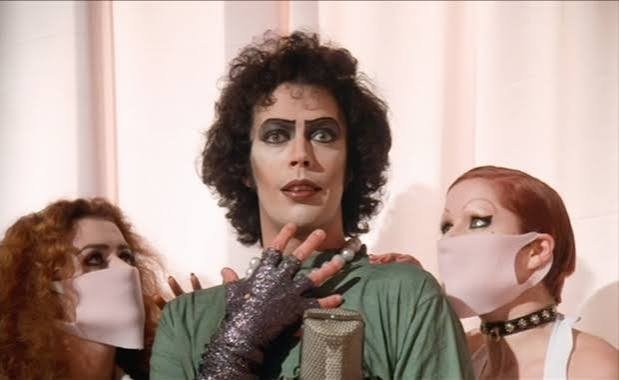
Curry originated Dr. Frank-N-Furter on stage in London in 1973, played him again in Los Angeles in 1974, and carried him into Jim Sharman’s film in 1975. The movie flopped. Fox pulled it from most of its initial run, and it survived because midnight audiences refused to let it die, starting with the Waverly in New York in the spring of 1976.
What survived, specifically, was him.
The performance runs on a kind of controlled excess that should not hold together. Frank is funny and openly sexual and completely willing to hurt someone, and Curry plays all three registers without ever announcing a shift. Watch him during “Sweet Transvestite.” He is flirting, he is boasting, he is also very clearly the most dangerous person in the building, and the audience is being invited to enjoy all of it at once. Then, near the end, the whole thing cracks open and he is genuinely wounded, and the movie lets you feel bad about how much fun you were having.
That is the reason people still put on the corset half a century later. Frank-N-Furter is not a costume of a villain. He is a host, and the party is at his house, and the rules are his.
Pennywise Knew Your Name

The two-night ABC broadcast of Stephen King’s It in November 1990 gave a generation of kids a very specific problem, which is that they could no longer look at a storm drain casually.
Curry’s Pennywise works because he plays a clown who is genuinely trying to be pleasant. The voice is warm. The pitch is high and slightly wet. He calls Georgie by name. He introduces himself like they are two people meeting under perfectly ordinary circumstances. Everything about the first minute of that scene is a friendly adult being helpful, and Curry lets it run long enough that you start to relax, which is the trap.
The turn is where the performance becomes what it is. He does not snap into a growl the way the makeup would let him. He keeps the friendliness on and just adds pressure underneath it, so the same smile stops meaning welcome and starts meaning appetite. The face never changes much. What changes is what the face is for.
There is a case to be made that television constraints helped. He could not be gory, so he had to be charming, and charming is scarier when it will not stop. Curry played Pennywise as somebody who genuinely enjoyed the conversation. Not the kill. The conversation.
That reading stayed culturally dominant for decades, and it did it through a miniseries that a lot of people will admit does not entirely work. The rest of It has aged unevenly. He has not.
Darkness, and the Voice That Found You Anyway

Ridley Scott’s Legend, released in Britain in 1985 and in the United States a year later, put Curry under Rob Bottin’s extraordinary makeup as Darkness, a red demon with a horn span that looks like it should require its own building permit.
You cannot see his face. Not really. The prosthetics take it. And yet nobody who knows Curry’s work has ever mistaken that performance for anyone else, because the voice arrives before the character does, low and unhurried and amused by its own patience. Darkness is not stomping around trying to intimidate a princess. He is courting her. He is the same proposition as Frank and Pennywise in a different costume: come here, it will be interesting.
Curry spent a large part of his later career working in voice, and it was never a fallback. He won a Daytime Emmy for playing Captain Hook in Peter Pan and the Pirates. Curry was Nigel Thornberry, which means an entire cohort of kids absorbed his timing without ever seeing his face. He gave villains in animated films a theatrical scale that most of the medium had stopped attempting.
The Same Instrument, Pointed at a Joke

Clue came out in 1985, and Wadsworth is the clearest evidence of how the whole thing worked.
The famous sequence has Curry racing through the house reconstructing every murder at a full sprint, doors slamming, props flying, delivering enormous quantities of dialogue while physically exhausted and never dropping a syllable. It is a technical feat performed as pure farce. The precision that made Pennywise unbearable is doing comedy here, at the same speed, with the same absolute control over where the audience is looking.
He did versions of this everywhere. The concierge in Home Alone 2 in 1992, oozing hospitality he does not mean. Long John Silver in Muppet Treasure Island in 1996, playing a pirate opposite felt and treating it as a serious acting assignment. Rooster in Annie in 1982, all charm and no floor underneath.
Three Tony nominations, for Amadeus in 1981, My Favorite Year in 1993, and Spamalot in 2005. He never won one.
What Is Left

Curry had a stroke in 2012 that affected his speech and mobility, and he kept working after it, mostly in voice, appearing where he wanted to appear. He returned to Rocky Horror as the Criminologist and Narrator in Fox’s 2016 television remake, which played less like a cameo than a benediction. His memoir, Vagabond, came out in October 2025.
Reducing those final years to the stroke would miss almost everything Curry kept putting into them, so this is not the part of the piece where the story turns sad.
Here is what remains instead. Somewhere tonight, a theater full of people in fishnets is shouting at a screen, and they will get the words right, because they always do. Somewhere a kid is watching Georgie chase a paper boat toward a curb and deciding, right around the third time the clown says his name, that this was a bad idea.
Curry is still in both rooms, doing the same thing he always did. Smiling. Waiting to see if you come closer.