
“Lean and mean and tight” ishow director Zach Cregger described his upcomingResident Evilreboot, noting how it emulates the survival mechanics and oppressive atmosphere of the popular video game franchise. The original live-action film series, by contrast, is sprawling and stylistically varied, spanning years of story time, multiple continents, and acolorful assortment of narrative and aesthetic devices– wirework, CGI, 3D effects, anddei ex machina appear in spades. In terms of fidelity to the source material, these movies rank pretty low among film adaptations of video games. That said,the series succeeds as a “video game adaptation” in adifferent sense: it incorporates the logic of video games into its narrative and filmmaking, drawing on it to craft an arresting posthuman vision.
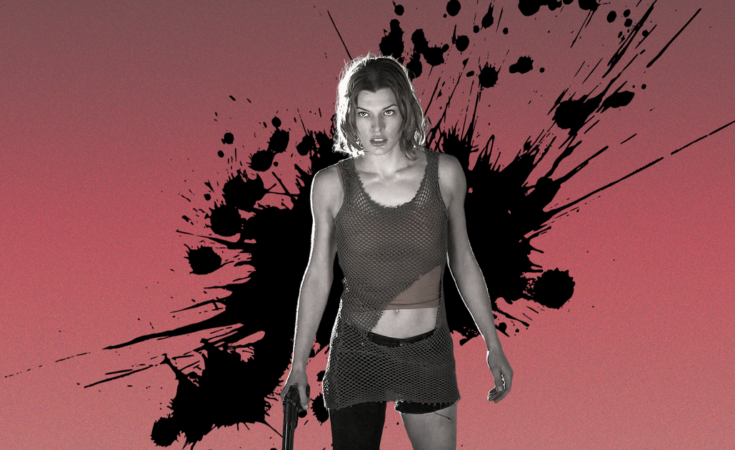
The story follows Alice (Milla Jovovich), aformer security operative for the Umbrella Corporation, apharmaceutical and biotech company whose technological, economic, and political clout means that it functionally rules the world. After aviral outbreak turns most of the earth’s population into zombies, Alice and her allies attempt to evade and thwart Umbrella’s ongoing machinations, culminating with amission to obtain an antivirus from the corporation’s headquarters.
Get more Little WhiteLies
Before we meet any human characters, however, we meet the “system.” The inaugural film, 2002’sResident Evil, opens with avideo game-style loadout screen that delivers a “confidential report” on Umbrella’s history. This kind of digital-readout-as-expository-device is nothing new. It does, however, represent amachinic “system’s perspective” that remains dominant throughout the series, framing and circumscribing the maneuverings of the human characters. In the very next scene, various security-cam views place us in the proverbial shoes of Umbrella’s AI security apparatus (the “Red Queen”) as it slaughters an entire facility of workers – the high-tech, spatially distributed equivalent of aslasher POV shot. In lieu of conventional establishing shots, scenes often begin with wireframe digital renderings of the space, populated by moving markers to show where characters are located.Such aesthetic choices embed narrative events within avast surveillance grid, which continually monitors, modulates, and gathers data on what the characters do.
In his bookGaming: Essays on Algorithmic Culture, media theorist Alexander Galloway notes how, unlike other media that “[assume] the form of aphysical object,” video games depend on the actions of both the player and the machine which encompasses the game’s hardware and software. Often, the machine keeps running in the background even when the player steps away, comprising what Galloway calls an “ambience act.” TheResident Evilmovies echo this phenomenon, their visual and narrative focus on digital models, simulations, and surveillance technologies generating asimilar sense of “ambient” machinic influence.
The gamic resonances extend even further: like an avatar, Alice repeatedly wakes up in new environments with no memory of how she got there, her actions guided by her immediate surroundings. Characters’ attributes often seem arbitrary: memories and abilities are wiped and restored at the screenwriter’s whim, costumes and allegiances swapping in and out like customizable skins within aloadout menu. Jill Valentine (Sienna Guillory), abrunette police officer in the series’ second instalment,Resident Evil: Apocalypse (2004), returns three movies later as ablonde, mind-controlled, upper-echelon Umbrella officer in apurple bodysuit.Dr. Alexander Isaacs (Iain Glen) shifts from being an Umbrella employee who mutates into atentacled creature at the end ofResident Evil: Extinction (2007), to being Umbrella’s very co-founder and CEO inResident Evil: The Final Chapter(2016), equipped with high-tech ocular implants that make him skilled in hand-to-hand combat.
This shift in Isaacs’ characterization is partially explained by the revelation that the first Isaacs was actually aclone. Cloning is first introduced in the third entry,Extinction, which opens with asurreal, nearly shot-by-shot recreation of Alice’s character introduction from the first film. As she walks, she suddenly ends up in the hospital where she finds herself at the end of the 2002 film, the blending of disparate spaces evoking the experience of dreaming – or perhaps, the act of toggling between different video game maps. We soon discover that she’s aclone who is violently killed and dumped in amass grave alongside other Alice duplicates. The sequence unfolds via eerily restricted narration: we think we’re seeing “our” Alice, only for the rug to be pulled out from underus.