
A mask does not move. It cannot sneer, flinch or smile, and that is exactly why horror has leaned on it for more than sixty years. A painted face that never changes turns an ordinary figure in a doorway into something the audience cannot settle on.
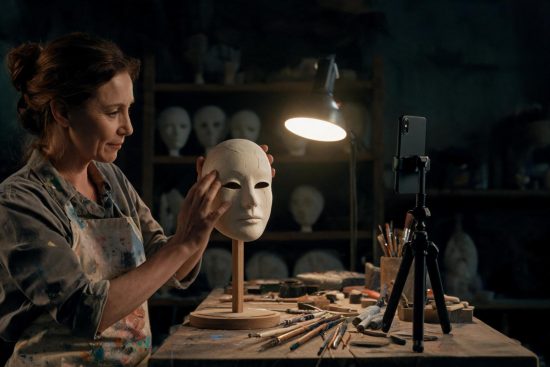
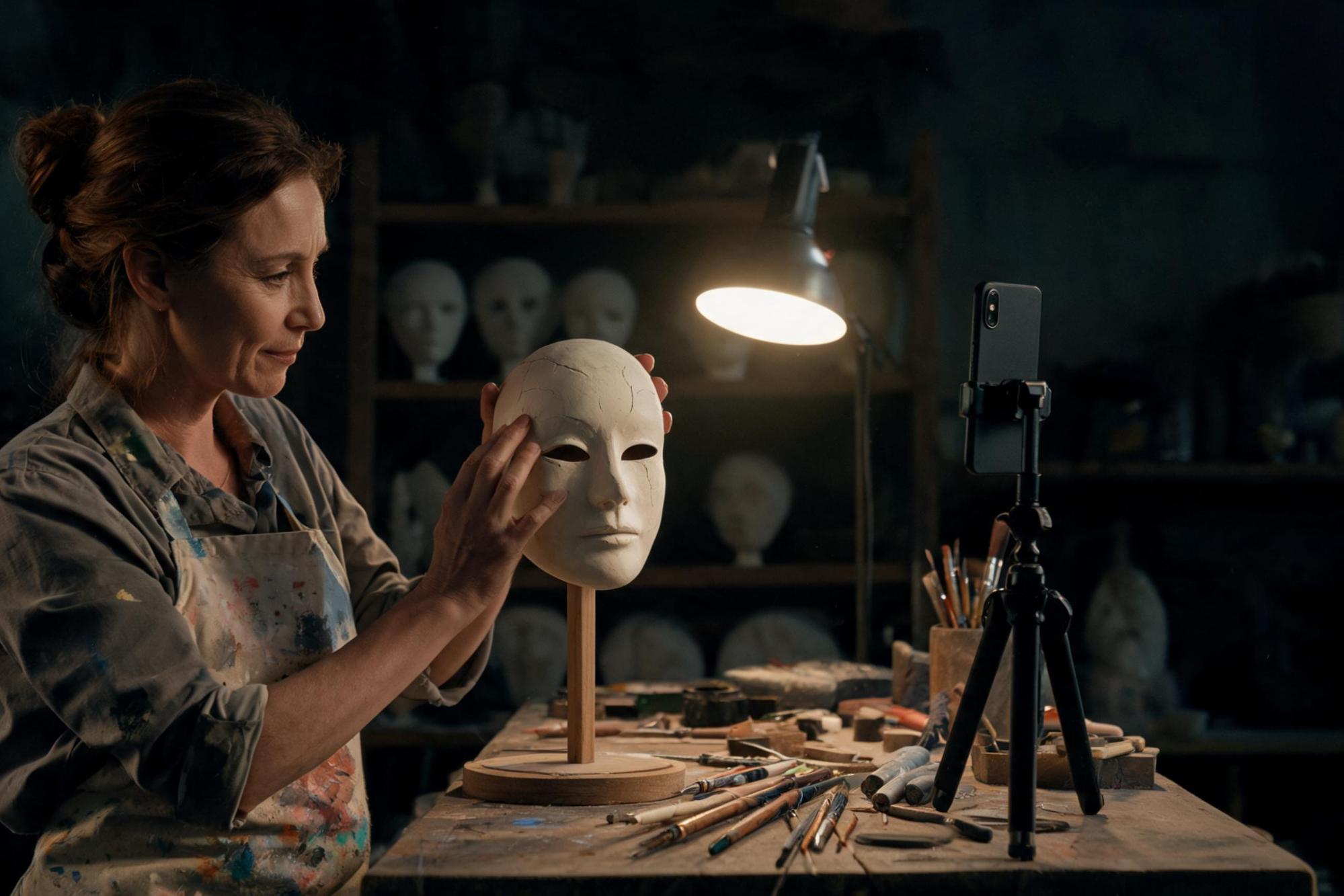
For the independent artists who sculpt and paint masks by hand, that stillness is also the hardest thing to show off online. One answer is a slow turn under a single lamp, filmed on a phone. A maker can then run that clip through ZenCreator to upscale video to 4k so the cracked paint, the seams and the grain of the latex hold up on a large screen.
Craft explains only part of the effect. Viewers spend every second of a scene reading the people on screen. A good mask quietly takes that job away. The unease that follows is one of the genre’s oldest tricks.
A Blank Mask Leaves the Audience Guessing
Most of what we know about a stranger’s next move comes from the face. A tight jaw, a quick glance, a half smile: we read these signals in a blink, often before we could explain them. They tell us whether to relax or to step back.
A mask cuts that line. The figure is still a person, with a body that walks and hands that can reach. But the part we check first gives back nothing. The brain keeps asking the question. It is the same small jolt we feel when someone we know stops talking and simply stares.
The mask never answers.
Horror lives in that gap. Viewers fill the empty expression with whatever they fear most, and each person fills it a little differently. The mask stays exactly the same while the audience supplies the menace.
Researchers Measured What a Covered Face Costs
Scientists have studied a much milder version of this problem. In a 2021 study in Royal Society Open Science, a team led by Eilidh Noyes tested 300 adults in three groups of 100. Their task was to name the emotion on photos of posed faces. Each face appeared for one second. Some photos were left uncovered, while others had ordinary sunglasses or mouth-and-nose face masks added digitally.
The gap was clear. Participants named the emotion correctly 80.48% of the time on uncovered faces, 76.32% with sunglasses and 61.51% with masks. Fear was among the hardest expressions to identify overall, at 53.19% averaged across all three conditions.
These were plain face masks, not horror props, and the study measured accuracy, not how uneasy anyone felt. Still, the results suggest how much work the lower face does when we read emotion. A horror mask usually covers all of it, and it often changes the eyes as well.
Stillness Does More Than a Sculpted Snarl
Mask makers tend to learn this the hard way. A mask carved into a permanent scream can look terrifying on a shelf. On a moving performer, it often turns comic, because the expression never changes and the scream starts to feel like a pose.
A neutral or slightly sad mask works differently. With no strong feeling on its surface, it fits any moment in a scene. It can look calm while its wearer does something alarming, and that mismatch is harder to shake than any snarl.
Georges Franju understood this in Eyes Without a Face (1960). His young heroine wears a smooth, pale mask with only the faintest features. She drifts through her father’s house like a sleepwalker, and the mask reads as grief as much as threat. The film unsettles through that sadness, not through shocks.
Traditional theater got there long before horror did. In Japanese Noh, performers wear carved wooden masks with deliberately neutral features. Tilting the mask slightly up or down changes how the light falls on it. The same face can seem to brighten or fall into sorrow. The carving stays still, and the performer’s angle does the acting.
Performers who wear masks learn the same rule with their bodies. Big gestures fight against a frozen face. Slow, deliberate movement lets the mask carry the scene, so a simple turn of the head can land harder than a lunge.
The Eye Holes Decide Everything
Where a mask meets the eyes is where most of the design lives. Wide openings show the wearer’s real eyes, wet and moving inside a frozen surface. Narrow or shadowed openings hide them, leaving two dark shapes that seem to watch without looking. Some makers set a thin layer of dark mesh behind the openings, which hides the wearer’s eyes while still letting them see.
Both choices work, for different reasons. Visible eyes remind viewers that a living person is in there, making decisions. Hidden eyes turn the figure into an object that happens to walk.
Lighting pushes either effect further. A lamp placed high throws the eye holes into deep shadow and flattens the face into a shell. A low light catches the rim of each opening and, now and then, a glint of something inside. Filmmakers, haunt designers and mask makers photographing their own work all use the same trick, often with a single bulb.
Paint matters too. A flat, even finish keeps the mask from showing any hint of mood. Cracks, stains and uneven color suggest a history the audience never gets to hear. Either way, the eyes remain the point the viewer returns to.
Filmmakers Stage the Mask Like Part of the Set
John Carpenter’s Halloween (1978) is the famous example. The production team bought a cheap mask of a TV character. They painted it a flat pale white and cut the eye holes wider. The result looks almost blank. Carpenter often keeps it at a distance: standing in a yard, half hidden between sheets on a clothesline, or framed in a doorway.
The figure never rushes. It stands and watches, and sometimes it tilts its head slightly, as if studying something it does not understand. That small tilt reads as curiosity, which feels far colder than anger.
Bryan Bertino’s The Strangers (2008) borrows the same stillness. One of its masked figures wears a rough sack with cut eye holes, and two wear doll-like masks. They often stand in the background of a shot while the characters in front go about their evening. The audience spots them first, and the masks’ fixed expressions do the rest.
Silence helps as well. The masked figure in Halloween never speaks, and the film never explains what he feels. With no voice and no expression, there is nothing left to read except where he stands and how long he stays there.
In both films, the camera treats the mask almost like furniture. It sits in the frame without drawing attention, the way a coat rack or a lamp might. That quiet placement is what makes it so hard to stop looking for it.
The Simplest Masks Are the Ones That Last
Horror has tried almost every kind of face covering, from rubber monster heads to elaborate prosthetics. Many look impressive for a season and then date quickly. The ones that stay in the culture tend to be the plainest: a white shell, a burlap sack, a porcelain doll face.
They last because they leave room. A detailed monster tells you exactly what to fear. A blank surface lets each viewer bring a private fear to it. That personal version is stronger than anything a designer could sculpt.
Restraint is often the last thing a mask maker learns. The quietest piece on the workbench, the one with the least expression, may be the one people remember longest.



![My Top 15 Horror Movies [Anti-Supernatural]](https://celebritynewsmag.com/wp-content/uploads/2022/02/maxresdefault-42-230x162.jpg "My Top 15 Horror Movies [Anti-Supernatural]")









.jpg?mbid=social_retweet "Geordie Greep Shows Cancelled Following Sexual Misconduct Allegations")