At this point in my career as afilm critic, it’s not often that afilm leaves me truly baffled – perhaps for that alone Maggie Gyllenhaal is deserving of some kudos. Unfortunately everything else about her woefully misguided take on The Bride of Frankenstein invites ridicule rather than recognition, to the extent that watching The Bride! evoked adeep feeling of second-hand embarrassment. How could afilmmaker who showed such promise with The Kindergarten Teacher and The Lost Daughter deliver such aspectacular misfire?
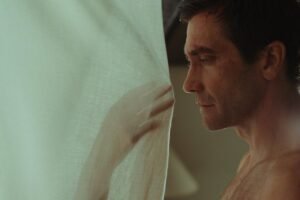
Jessie Buckley and Christian Bale reanimate the titular Bride and Frankenstein’s Monster (who goes by ‘Frank’ in 1936, still kicking 117years after his creation), shooting for Bonnie and Clyde but landing closer to am-dram Joker and Harley. The socially awkward Frank has arrived in Chicago in search of renegade scientist Dr. Cornelia Euphronious (Annette Bening) in hopes she might be able to bring his decades of clawing loneliness to an end by creating alover for him. Across town, good time gal Ida (Buckley) has just been thrown down aflight of stairs by gangster Clyde (John Magaro) after aparticularly wild night where she became possessed by the spirit of Mary Shelley (also Buckley) and caused quite the scene at dinner. Unfortunately for the already unlucky Ida, she’s the pretty corpse stolen from the local graveyard for Frank and Cornelia’s science project, and her dramatic rebirth as ‘Penelope’ sets in motion aconvoluted plot involving Chicago’s seedy gangsters, crooked cops and aFred Astaire/Gene Kelly stand-in played by Jake Gyllenhaal.
Get more Little WhiteLies
If this all sounds abit frantic and incoherent, that matches the energy of Gyllenhaal’s film. Buckley, playing essentially three characters at once, delivers an animated but undeniably odd performance, with the ghost of Shelley still present post-resurrection, manifesting in verbal tics that read similar to those experienced by people with Tourette Syndrome. Qualifiers like “good” and “bad” don’t seem to exist for aperformance like this. Buckley’s certainly doing alot, matching her director’s “throw everything at the wall and see what sticks” approach to the script. It’s the sort of role that one imagines amiddle-aged male studio exec thinks is wildly progressive – anotion underlined by ascene where Buckley monologues about her pain and rage, culminating in arepeatedly cry of “WHAT ABOUT ME TOO?”
The Bride!‘s bolshy insistence that it’s aradical story of female emancipation is not backed up by Gyllenhaal’s writing which is fixated on aworldview that feels comically dated. When Penelope and Frank go on the lamb after astring of murders, her distinctive appearance sparks aviolent revolution among young women who apparently idolise her, while repeatedly instances of sexualised violence tell us absolutely nothing we don’t already know about what life was like for women in the 1930s (not that the 2020s are much improved). Even Penelope’s rage against her repeated exploitation feels hollow; she’s extraordinarily quick to forgive Frank despite his continuous betrayals and there’s never any real sense that the love between them is anything more than proximity bias. Gyllenhaal seems determined to make The Bride! alove story at odds with everything we’re seeing and hearing these characters do.
The cloying, laughably broad and dated gestures at feminism are at least an intentional artistic choice no matter how poor. More egregious are the multiple continuity errors and poorly staged dance numbers – there’s aslapdash quality at hand which makes The Bride!‘s rumoured $100 million budget as confusing as the overburdened plot. As such it’s difficult to not look at The Bride! and compare it to Yorgos Lanthimos’ Poor Things, which similarly draws from Shelley’s novel and concerns an abused woman dragged back to life through no desire of her own who must set out to discover both her past and future. While Lanthimos’ maximalist odyssey could hardly be accused of subtly, it seems shy and retiring next to afilm as obnoxiously misguided as The Bride! yet explores female autonomy and exploitation with considerably more thought andcare.
This lack of subtlety extends to the references that overload The Bride! with stars including Ginger Rogers, Marlena Dietrich and Ida Lupino all getting anamecheck, and poor Jeannie Berlin subject to the indignity of reciting ‘Romeo &Juliet’ in reference to Frank and Penny. Such brashness could be forgiven if the result was afilm that felt remotely challenging or disruptive, but The Bride! doesn’t have asingle original thought worth pursuing. The fact that this film appears so shrilly convinced of its radical praxis speaks to abizarre disconnection from reality.