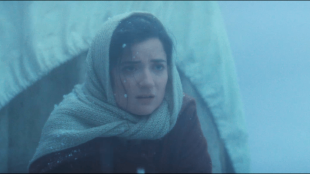
If anyone was going to try to adaptSilent Hill 2, one of video gaming’s most spectacular artistic achievements, you could do worse than French stylist Christophe Gans, who directed 2006’sSilent Hill – aloose adaptation of the first game in the series. Much to fans’ chagrin, the film rewrote the game’s story, but it did maintain its eerie atmosphere and disturbingly graphic imagery. Gans’ new film,Return to Silent Hill, is in some ways amuch more faithful and loving console-to-theater transformation. We still follow James Sunderland (Jeremy Irvine), amorose man drawn to Silent Hill by amysterious letter from his missing wife, Mary (Hannah Emily Anderson).
Gans also returns to the first film’s gloomy digital style, enveloping actors in oppressive CGI fog and synthetic environments. It obviously recalls Konami’s original game, whose technical limitations foregrounded its artificiality, but it’s also achilling way to emphasize that protagonist James is trapped in ahell of, if not his own, thensomething’s making. The performances too somehow emulates the game’s awkward, unnatural voice acting, akey contributor to both works’ uncanny dreamlike ambience. Rarely has afilm better evoked aPlayStation 2game.
Get more Little WhiteLies
Game fans can be precious aboutSilent Hill 2, and Gans goes the distance to reassure them of his good intentions.Return to Silent Hill follows the game’s structure closely, moving through almost all of its major beats with shot-for-shot recreations of its most iconic images. Yet it does undeniably make some bewildering changes. Many of them simply don’t work at all: One key twist reframes James’ role in his wife’s disappearance in away that obliterates one of the game’s most challenging narrative elements. Other alterations trade the game’s strange poetry for adisappointing literalism; Mary’s letter no longer begins with the captivating phrase “In my restless dreams, Isee thattown.”
In other ways, though,Return to Silent Hillfeels like aproductive reinterpretation of the source material, anew take on its themes and iconography in lieu of arote recapitulation. The story’s secondary characters, whose original incarnations darkly reflect James’ own neuroses, are rewritten as aspects of Mary instead. For someone intimately familiar with the game’s story, this was awelcome and intriguing surprise. In trimming things down to 100minutes, Gans gives the story new propulsiveness. Without any of the game’s tension-releasing exploration and puzzle-solving breaks, it has anightmare flow, constantly upending its own logic and the geometry of its spaces. It denies the audience the brief, comforting respites they expect in other horror films.
Still, it necessitated some trimming. Fans will riot – that’s what they do. But this kind of interpretative adaptation is preferable to the game’s 2024 remake, aslavishly faithful “modernization” that sanded down all of the original’s rough edges.Return to Silent Hill, whatever else you can say about it, produces afruitful artistic friction. In that way, it understands the assignment.









.jpg "Converge Announce Second Album of 2026, Share New Song")