
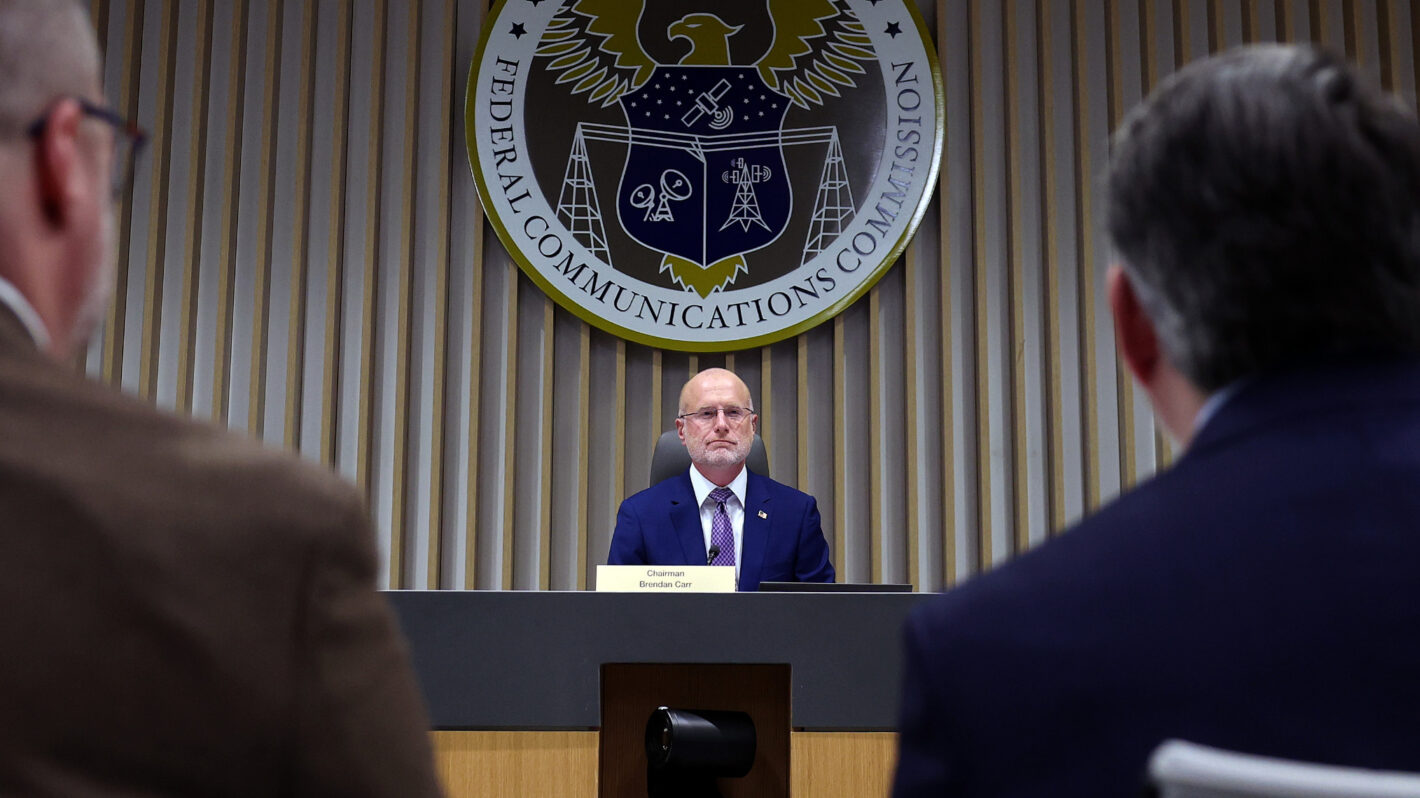

If it feels like the Federal Communications Commission has gotten more press in the past 18 months than it got in the previous nine decades, you can thank Brendan Carr. President Donald Trump named Carr, a longtime FCC commissioner and a Project 2025 contributor, as FCC chairman in November 2024. And since then, Carr has been using enforcement actions, official letters and statements, and even a podcast interview to reshape the media landscape.
Meanwhile, critics — including some within the FCC’s own ranks — have accused Carr of bullying media companies into bowing to conservative policy goals. “The goal is to get companies to capitulate in advance, to the point where the FCC or the administration doesn’t even need to speak,” FCC Commissioner Anna Gomez told Politico in September 2025. “It’s the process that’s the point. It’s the threats that are the point.”
And Ari Cohn, lead tech counsel for the Foundation for Individual Rights and Expression, told Poltico’s Digital Future Daily newsletter that same month that the Carr-era FCC is using “whatever regulatory tools [it] has laying around at its disposal to punish speech with which the [Trump] administration disagrees.”
Here are five ways Carr has been wielding those tools.
1. Threatening broadcasters through equal-time and news-distortion rules
Carr has been drawing unprecedented lines around which TV shows are news programs and which aren’t, as Politico reported. He applied an FCC rule about “news distortion” to both 60 Minutes for a Kamala Harris interview — before Paramount paid Trump $16 million to settle a lawsuit over the same segment — and, controversially, to Jimmy Kimmel Live! — after host Jimmy Kimmel made divisive quotes about the Charlie Kirk killing. Carr also threatened federal action against ABC affiliates who carried Jimmy Kimmel Live!, even going so far as to say, “We can do this the easy way or the hard way,” per NPR.
The FCC chair has also been casting skepticism that The View qualifies as a news interview show exempt from the equal-time regulations that require competing candidates to have the same access to broadcast TV during an election, according to Politico. And recently, this February, Stephen Colbert blamed CBS lawyers’ interpretation of the FCC’s equal-time guidance for the cancellation of a Late Show interview with Texas State Rep. James Talarico. In the same monologue, Colbert called out a January 2026 letter in which Carr considered dropping equal-time exemptions for talk shows he considered “motivated by partisan purposes.”
2. Advocating for the defunding of PBS and NPR
In January 2025, Carr wrote a letter to the presidents and CEOs of PBS and NPR to inform them that he had ordered the FCC’s Enforcement Bureau to investigate whether those public media organizations’ member stations violated federal law by “running commercial advertisements” in their acknowledgments of for-profit underwriters.
“To the extent that these taxpayer dollars are being used to support a for-profit endeavor or an entity that is airing commercial advertisements, then that would further undermine any case for continuing to fund NPR and PBS with taxpayer dollars,” he wrote in the letter, which The New York Times obtained.
Carr also told the execs he “[did] not see a reason why Congress should continue sending taxpayer dollars to NPR and PBS.”
Seth Stern, the director of advocacy at Freedom of the Press Foundation, told the Times Carr seemed to be readying for a larger fight against public media. “The end of Mr. Carr’s letter tellingly goes far beyond underwriting and talks about his thoughts on whether public media should be funded at all and notes that this underwriting issue might be relevant to a broader legislative debate,” Stern said.
That July, Congress approved rescinding an allocation of $1.1 billion to the Corporation for Public Broadcasting (CPB), thereby ending federal supportfor NPR, PBS, and their member stations, as NPR reported.
3. Pressuring media companies to end DEI practices
In February 2025, Carr announced he was investigating NBCUniversal and parent company Comcast over its diversity, equity, and inclusion (DEI) efforts, which he claimed were “odious to a free people whose institutions are founded on a commitment to equality,” per ABC News.
Geoffrey Starks, then an FCC commissioner, expressed “grave concern” over the enforcement action, saying it was “out of our lane and out of our reach.”
Paramount, which had its Skydance merger up for FCC review at the time, told employees that same month it was pulling back on DEI policies, according to The New York Times.
In March 2025, Carr announced he was ordering an investigation into the Walt Disney Co. and ABC over concerns the companies were promoting “DEI discrimination,” per NPR. That same month, he indicated he would block mergers and acquisitions between companies with DEI initiatives, according to Bloomberg.
4. Giving local broadcasters more leverage over networks
Under Carr, the Trump-era FCC has also boosted local broadcasters’ power in the media ecosystem, Politico reported this month. For instance, the commission approved a $6.2 billion Nexstar–Tegna merger set to create a media giant that reaches about 80 percent of U.S. households. Carr also told Politico he wanted to make it easier for TV stations to preempt network programs without breach-of-contract penalties. “There’s a very healthy feedback loop when the local broadcasters could not just communicate their concerns to the national programmers but, if need be, actually preempt,” he said.
Again, Gomez criticized the commission’s actions. “When the FCC’s campaign to cancel Jimmy Kimmel failed, thanks to the loud, public outcry from local communities, the agency quietly went looking for a censorship backdoor,” she said in a statement to Politico. “That’s why it is suddenly very interested in using affiliate broadcasters to indirectly pressure networks into dropping programming it dislikes.”
5. Questioning appropriateness of LGBTQ-inclusive children’s TV
In another development this month, the FCC launched an inquiry into TV ratings for children’s TV programs, stating that parents were concerned that “controversial gender identity issues” are being included in children’s TV programs and that “industry guidelines that parents rely on are rating shows with transgender and gender non-binary programming as appropriate for children and young children,” per Deadline.
The inquiry set off alarm bells for LGBTQ advocates and allies. “Parents should absolutely have a say in what their kids watch, and parents already know that seeing an LGBTQ person on screen or in real life does no harm,” GLAAD President and CEO Sarah Kate Ellis in a statement. “What does cause harm is government overreach. Under Brendan Carr, the Federal Communications Commission is once again attempting to dictate what can be seen on television. … But this is about more than television. It’s about whether a government agency gets to reshape culture, limit storytelling, and undermine free expression.”

































)