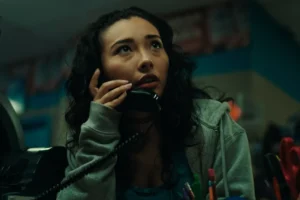
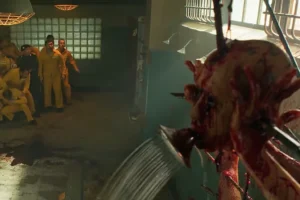
The official trailer for Jane Schoenbrun’s Teenage Sex and Death at Camp Miasma is here. The film opened the Un Certain Regard section at Cannes 2026 and came back with reviews that have critics sounding slightly unhinged in the best possible way.
The Film

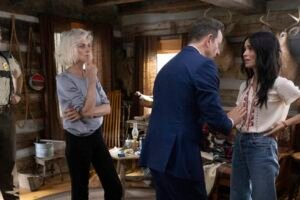
Hannah Einbinder plays Kris, a young director handed the task of resurrecting a long-dormant slasher franchise called Camp Miasma, one that has survived years of slapdash sequels and a fanbase kept alive mostly by loyalty and stubbornness. Her plan for the revival involves recasting the original final girl. The original final girl is Billy, Gillian Anderson, who has not been seen publicly in a very long time and is currently living on the campground where the original film was shot.
Kris finds her anyway. What follows is a descent into psychosexual mania, which under Schoenbrun’s direction means something considerably stranger and more specific than that phrase normally promises. Think less “moody thriller with longing looks” and more “what if the slasher franchise was never really about the killer.”
Who Is Jane Schoenbrun

Her debut, We’re All Going to the World’s Fair, premiered in the Next section at Sundance 2021. It followed a teenage girl participating in an internet horror role-play game, shot on a camera that felt like it was being held by someone who understood what teenage loneliness online actually felt like, not from reading about it but from having lived inside it. Schoenbrun wrote it before she began physically transitioning, working through her early internet years and what it meant to inhabit a body she had not yet figured out. The film cost almost nothing to make and feels like it cost everything.
Before directing, Schoenbrun programmed the series “Photographing the Ether: The Internet on Film” for the Brooklyn Academy of Music. She is a curator’s filmmaker, which is to say she thinks about what a film does to the body before she thinks about what it means. Most directors build the plot and let the feeling arrive on its own. Schoenbrun builds the feeling and lets the plot catch up. With Camp Miasma, it sounds like she ran.
What TV Glow Did

I Saw the TV Glow came out on A24 in May 2024 and did something unusual for a horror film. It spread without being pushed.
Not through advertising. Not through platform placement. It moved through queer and trans communities the way something moves when it names a thing people already knew but had no words for. Two suburban teenagers bond over a fictional supernatural TV series called The Pink Opaque, and something in the texture of that bond, in the specific quality of their attachment to a world that is not their own, landed with a precision that criticism struggled to keep up with. Justice Smith and Brigette Lundy-Paine carry it in performances tuned to exactly the frequency Schoenbrun is operating at.
The line “There is still time” became a phrase tattooed on people’s bodies by August. That is not a metaphor. People had it tattooed on their bodies by August. That is the mark of a film that worked at a level marketing cannot manufacture.
Schoenbrun has talked about the concept of the “egg crack” as central to what the film is doing. The moment when a person stops finding reasons they are not trans and admits for the first time that they are. I Saw the TV Glow is a film about that moment, except it does not call it that. It puts it inside a story about a TV show and two kids in a suburb and lets the horror do the work.
Schoenbrun After TV Glow

Camp Miasma is not slow horror. It is not atmospheric dread.
Schoenbrun has talked openly about wanting to make a film about finding joy after transition, specifically about sex, desire, and the parts of queerness that horror tends to treat as transgressive rather than just human. She then decided to build that film inside the rotted infrastructure of an 80s slasher IP. With all the baggage that entails about what final girls are for, who is allowed to survive, and what happens when two women pull an entire franchise off its rails. The result, according to everyone who saw it at Cannes, is genuinely funny, genuinely frightening, and not remotely what anyone who came in expecting either one was prepared for.
August 7