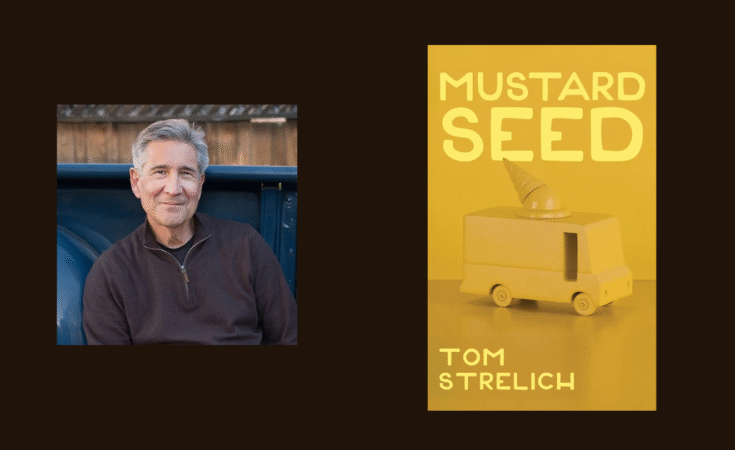

What’s the story behind the story? What inspired you to write this book?
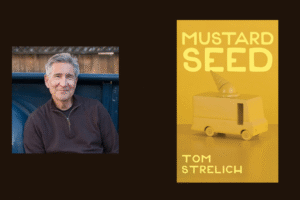
I started out as a playwright, and I wrote a play, “Dog Logic,” that was produced in New York and won some awards and such. But sometimes, as a writer, you create a character that you can’t let go of, and that won’t let go of you, and I had such a character in Hertell Daggett, the damaged caretaker of a rundown pet cemetery. I wanted to take him on a new adventure—same character, same setting, but a completely new story, an epic story this time.
So, I wrote the novel, Dog Logic, a funny and epic satire as the first in a series of books which I call the Dog Logic Triptych (I’ve always been a fan of Hieronymus Bosch). It was followed by Water Memory, the sequel, which picks up ten years after the end of Dog Logic—it’s even more epic than the first book.
Both books went on to win multiple awards, and when I checked with readers to see what they wanted to read next in the series—the sequel to Water Memory or the prequel to Dog Logic—the vote was for the prequel, thus Mustard Seed. However, I wrote all of the books as stand-alone novels, so they can be read in any order. The reader doesn’t need to have read Dog Logic to enjoy Mustard Seed (though I hope it makes them want to read the other two books to see what happens next).
If you had to pick theme songs for the main characters of your book, what would they be?
“What a Wonderful World” (sung by Louis Armstrong)
What’s your favorite genre to read? Is it the same as your favorite genre to write?
I know it’s kind of weird for a fiction writer, but I mainly read nonfiction (e.g., science, history, philosophy, etc.). When I do read fiction, it’s either a classic (like Moby-Dick or Don Quixote) or a literary satire of some sort (e.g., Candide, The Fall, etc.). And as you’d expect, literary satire is my favorite genre to write in as well, since satire is the perfect literary platform because it allows both the writer and the reader to explore the landscape of the human experience—the absurdity, the grandeur, the mystery, the horror—not with a sermon or a polemic or a sigh, but with a laugh and a nodding smile of recognition.
What books are on your TBR pile right now?
The Philosopher’s Secret Fire by Harpur — fairies, UFOs, etc.
National Audubon Society Field Guide to Trees — I’m a failed botanist.
The Phenomenon of Man by Teilhard de Chardin — 2nd try.
The World as Will and Representation, Vol. 1 by Schopenhauer — 3rd try.
What scene in your book was your favorite to write?
Well, of course they’re all my favorite, and I loved writing each one of them, but if I had to pick one, I think it would be a scene early on in the book in which an Air Force airman (basically a private) is entering the ultra-top-secret Cheyenne Mountain nuclear bunker and engages in a highly classified challenge-response sequence in the form of a knock-knock joke. It was fun to write and also perfectly sets the tone for the rest of the book.
Do you have any quirky writing habits? (lucky mugs, cats on laps, etc.)
I don’t know if it’s a habit or just a quirky practice. In any case, it’s a technique I’ve used since I was a playwright, in which I’d intentionally write myself into a corner, such that the reader (or audience member) wonders, “How does he get out of this?” This would force me to come up with something—a twist, an unexpected turn—to send the story in some unpredictable direction. It made the writing process fun and helped keep me (as I wrote it) and the reader (as they read it) guessing about where the story was going to go.
Do you have a motto, quote or philosophy you live by?
Yes, “Fiction slightly askew” is my motto because I’ve always operated under the belief that you can’t make up stuff any weirder than it really is. No need for magic wands, alien life forms, or mystical powers—just characters, their circumstances, the events that overtake them, and their responses, and all of it happening in a world just like the real one we live in, but not quite the same: a realistic, or at least recognizable, world just like ours, only a little bit off to the side and tilted at an odd angle (i.e., fiction slightly askew).
If you could choose one thing for readers to remember after reading your book, what would it be?
That they laughed out loud many times and thought deeply many more … oh wait, that’s two.