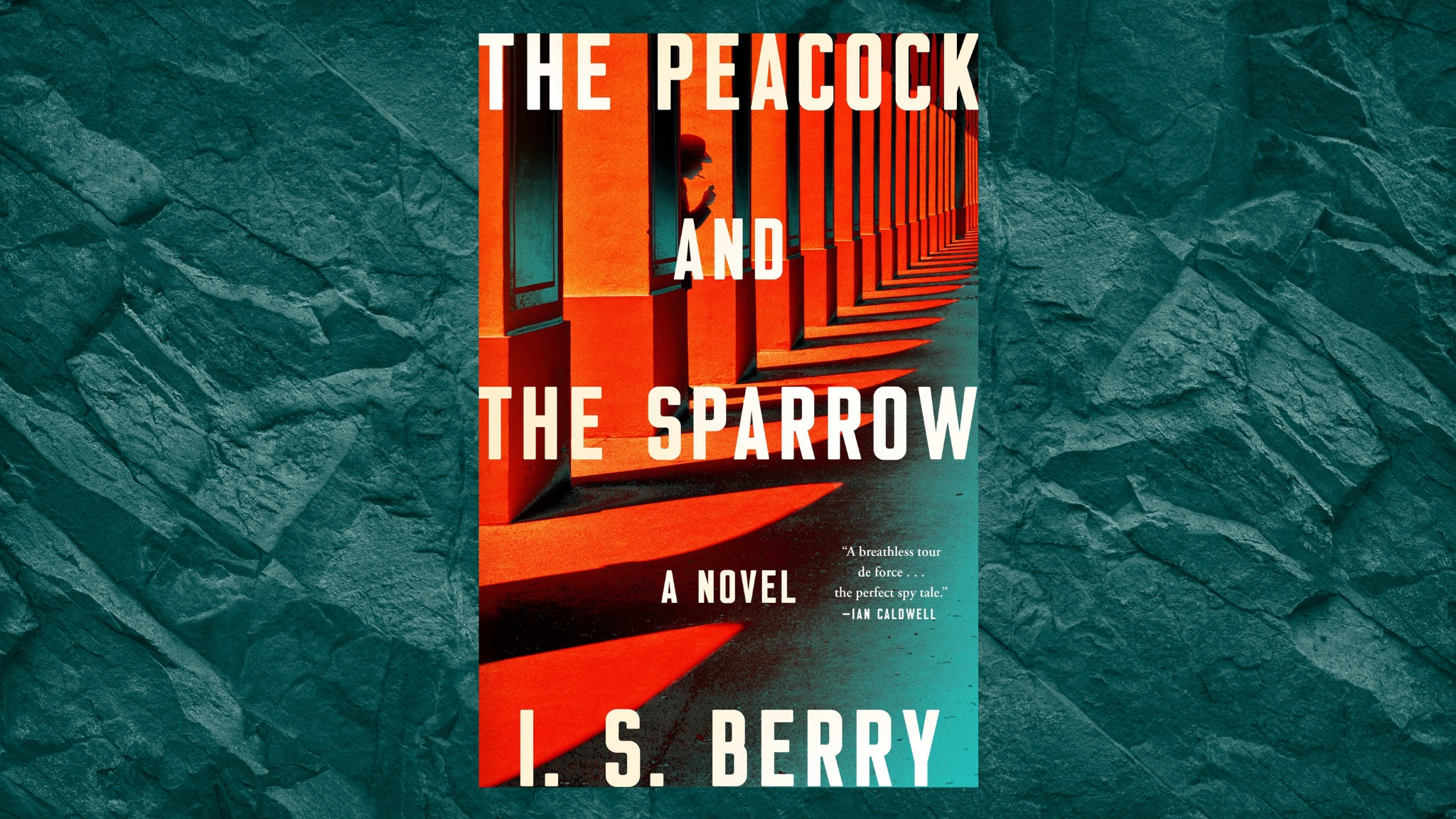
The Peacock and the Sparrow by I.S. Berry
I had no marketable skills, no human attachment worth the name, no life alternatives. All I had to do was gut out the remainder of my tour the way I’d managed to gut out all my tours – quietly, neither glaringly successful nor unsuccessful, a near-invisible piece of flotsam carried by the stinking sea of sludge.
In I. S. Berry’s The Peacock and the Sparrow (Atria), it is the Arab Spring in Bahrain, and for Shane Collins, a divorced 52, over twenty-five years a spy, his career a multiyear descent, it is his final CIA posting. For two years, the country has been stuck “in a messy attempt at revolution … stalled in an advanced percolation stage: violent but not particularly deadly.” His job is to find evidence that the Iranians are supporting the insurgency against the monarch – his superiors here and in Washington really want to get the Iranians – and for that he cultivates informants while trying to make as few waves as possible.
But then two things happen: his most trusted informant becomes involved in a murder in order to save Collins’ life, and Collins meets a beautiful, enigmatic artist and activist named Almaisa. He feels beholden to the first, and falls in love with the second, and slowly, inexorably, as he encounters a side of Bahrain few outsiders experience, his life turns upside down.
He begins to take sides, to use his skills to help those he thinks need it most – “I was a spook, for Christ’s sake … Behind me was a lifetime of deflecting notice and attribution, perfectly angling the mirrors so nothing was revealed.” As events accelerate, however, and the violence increases, he finds himself drawn deeper and deeper, the lines between the personal and the professional blurring. Secrets are everywhere. Betrayal waits around every corner. Who is the handler? Who is being handled?
Caught in the nexus of the United States, Russia, Saudi Arabia, Iran, and Bahrain, Collins can only soldier on, groping in the dark, knowing that he may never know the answers – or want to: “Sometimes knowledge caused unpleasant consequences. Liability, questions. Doubt.”
Death.
The Peacock and the Sparrow is a classic contemporary spy story filled with twists, rich with atmosphere and adrenaline, informed by the kind of authentic detail only an insider like Ilana Berry could know. For six years, she was an operations officer for the CIA in wartime Baghdad and elsewhere, including Bahrain.
“I lived in Bahrain for two years, and was fascinated by the complexity of the Arab Spring. It wasn’t just democracy versus dictatorship, it was a battle for territory and identity; multiple countries and players were involved; there was no clear ‘right’ side. Walking through the streets, I would see palaces and luxury hotels alongside slums, heavily-armed riot police battling street urchins. Such vivid, profound contrasts. More questions than answers. It was perfect material for a spy novel.
“Most of my descriptions are based on my observations. In Bahrain, I explored the entire island. When else, I reasoned, would I have a 360-degree view of the Arab Spring? I journeyed to the slums, the first oil well, the tree of life. I remember exploring Qal’at al-Bahrain (Bahrain Fort), then quickly fleeing when a riot erupted and tear gas filled the air. I recall the beauty of the evening call to prayer. I got to know immigrant laborers; I witnessed how badly they were treated. At times my descriptions are precisely what I remembered, at times amalgamations, at times metaphoric.
“My descriptions of Bahrain’s expat community are also based on my observations. I was intrigued by how many Westerners seemed to adopt the mindset of the local ruling class — purchasing luxury goods, getting plastic surgery (so-called “medical tourism”), hiring live-in housekeepers and nannies. Westerners seemed to lose the values they’d purportedly come to promote. This perversion was fertile material for a book. And real life, I found, was often better than fiction: much of the dialogue between expats is based on actual conversations.
“Bahrain, I felt, needed to be a character in the book — throughout the story, it’s as complex and changing as a human — and in order to give it flesh and blood, I needed to write authentically.
“When I started, my book wasn’t strictly a spy story — more like a spy-flavored thriller. But I realized the scenes that dealt with espionage had a luster and authenticity the rest did not. So I changed course. While writing, I came to appreciate the depth a spy novel can hold. Espionage is a prism for the weightiest issues humans face: choosing what side you’ll fight for; weighing ends and means; deciding whether and how to compromise yourself. I found myself connecting with the story — and processing my own experiences as a spy — in meaningful and unexpected ways.
“Spying is a profession of haunting uncertainty. I served for one year in wartime Baghdad, and later learned a man I helped apprehend might not, in fact, be a terrorist, that he might not be guilty of his alleged crimes. It’s an irresolution that still haunts me. When recruiting sources, you don’t always know whom to trust, who’s genuine and who’s deceitful. I wanted to write a story that captured this sense of disquiet, where truth is elusive and questions unanswered.
“Also important to me was that my characters felt real, that they weren’t glamorous, heroic, or pat. Spying is based on manipulation, persuading someone to betray his country. I wanted the protagonist, Shane Collins, to bear the scars of this life. I think my distaste for the profession comes out in Collins.
“When writing the armed conflict scenes, I drew heavily on my experience in Baghdad. The sound and smell of burning classified documents, the prickle of pebbles raining down from a mortar attack—these are sensations I experienced. In one scene in my book, I describe soldiers gesticulating with “death-cusp urgency.” Those were the precise words that came to my mind when I witnessed soldiers being carried into a Baghdad hospital after an IED attack.
“Above all, I tried to capture a visceral sense of what it’s like to be a spy. The loneliness of secrets, the debilitation of constantly watching and being watched, the sense of living in a no-man’s land.”
How did she come to work for the CIA?
“In college, I fell in love with the great beyond. I studied abroad at the London School of Economics, backpacked across Europe, taught English in Poland. It was the nineties, an exciting time—the Cold War had ended and the world was transforming. I was particularly fascinated by Eastern Europe’s transition from communism to democracy. So, after graduating, I shoved everything I owned into a suitcase and headed to Prague. I found a job as an editor for an online newspaper. I lived above the famed Roxy nightclub, then moved into the flat once occupied by Czech writer Jan Neruda (true story!).
“Eventually, I needed a job that paid the bills. I’d become well-versed in post-communist politics, so I moved to Cambridge, England to work as an intelligence analyst for the U.S. Department of Defense. I traveled frequently to the Balkans, working alongside the military, CIA, and peacekeeping organizations. I loved living overseas and being in the maelstrom of international issues, providing output that would directly influence policymakers. After a few years, I applied to the CIA.
“While waiting for the Agency to process my application (the speed was glacial in those days), I went to law school, focusing on national security and international law. When September 11 th happened, I remember feeling grateful I would be able to serve my country. Finally, I got the call and began training to be a case officer.
“After leaving the Agency, I practiced national security law for a small firm. Our clients were largely government employees, whistleblowers, authors. When I had my son, I stepped back from law to be a mom. I found my days as a spy wouldn’t let me go. My memories were restless. So I started typing.
“I did have to do some research, mostly on technical or logistical questions, like what quantity of explosives would knock out a Navy destroyer, or how people would be evacuated from an embassy. I read plenty of books and articles (always worrying that the FBI would come knocking on my door, looking for the person who kept googling bomb-making techniques), but relied heavily on an online alumni group from my math-and-science high school. These alumni were a great resource. They could answer crazy questions like what kind of explosives turn things purple.”
She also drew on her literary influences.
“Graham Greene, first and foremost. Even before le Carré, Greene proved that spy novels can rise to the level of literature, that they can be at once profound and thrilling and exquisite. Every sentence in The Quiet American is poetry, and The Human Factor isn’t far behind. And Greene was a master of moral convolution. I love how his stories portray international forces at a human level.
“C.J. Koch, who wrote The Year of Living Dangerously and Highways to a War also influenced me. He portrayed global conflicts in such rich, lush prose; time and place were full-bodied characters. (Some of the scenes in my book — tuk-tuks circling below Collins’ hotel room — pay homage to Koch.)
“Vladimir Nabokov’s wonderfully dark and disturbing book, Lolita, made an indelible imprint on me when I read it in college. In lyrical, sparkling prose, Nabokov somehow manages to elicit in the reader a hint of sympathy for a monster. To me, that’s the essence of great writing.
“Tim O’Brien was revolutionary: for the first time, I understood how fiction can tell the truth better than nonfiction, how stories can distill and evoke reality in a way bare facts cannot.
“The list goes on. Literary references are sprinkled throughout my book: T.S. Eliot, Edgar Allan Poe, even Shakespeare.
“Great authors taught me how to write, but life experience gave me something to write about. Spying, living and working in a war zone, traveling the world — these were invaluable in crafting The Peacock and the Sparrow. Watching headlights slither across the ceiling of a fleabag hotel room. The scattered light of a disco ball in a Cambodian bar. It was as if all these motley tiles I’d collected over the years were just waiting to be part of a mosaic.
“While living in Prague, I tried my hand at writing a novel. (After communism fell, Prague became a Left Bank of sorts, where just about every expat was an aspiring artist or writer.) It went nowhere. I needed to live a bit more.”
Even with all that acquired life experience, however, doing the book was still not easy.
“Because of the CIA’s prepublication requirements — an employee or former employee cannot even show her work to anyone until it has been reviewed by the Agency for classified information — I wrote my book in a vacuum. It’s a lonely process and a leap of faith — there’s no one along the way to give you feedback or cheer you on.
“As a new writer, I had no idea how to pitch to agents. I had little formal education in creative writing, no real writing credentials, no connections. I did some research, but didn’t follow some of the (more expensive) advice I found, like subscribing to Publishers Marketplace. In the end, I felt my book spoke for itself.
“Multiple agents offered to represent me, which was way beyond my boldest expectations. The agent I chose, David McCormick, seemed to understand my book perfectly.
“The process of finding a publisher took place during the pandemic, so there was a lot of uncertainty and turmoil, moments when I felt discouraged. I had my hopes set on one editor in particular at Simon & Schuster, Peter Borland, who edited Joseph Kanon, a literary spy novelist whose work I admired. And lo and behold, Peter was the key that clicked.
“Perhaps the most common question I faced throughout the process was why, as a female, I didn’t write a female protagonist. The answer is simply that the story called for Shane Collins; only he fit the bill. (And I like to point out that one of the central characters is, of course, female.)
“The protagonist’s voice was key; it set the tone. I gave a lot of thought to Shane Collins’ character and backstory, drawing on people I’d known and worked with, and kept it all in my mind while writing. Sometimes I’d accidentally write a sentence as myself; then I’d stop and remind myself I’m Collins, not Ilana. Maybe I needed to be more bitter, more damaged. Maybe I needed a drink. I really tried to inhabit him. It’s a true benefit to writing — you develop an ability to understand, to some degree, someone unlike yourself, to develop a kind of empathy.
“In the spirit of espionage, I deliberately didn’t resolve a few questions in the book. I invite readers to draw their own conclusions. I wanted the story to contain a reserve of mystery — even for me. The story, after all, felt like a living thing, with its own thoughts and secrets.
“I hope The Peacock and the Sparrow opens a window into a fascinating and otherwise closed world, and makes people think. And I’m eager to hear readers’ thoughts … there are so many questions in the book just begging for answers.”
What’s next? “Another spy novel! The first in a series, I hope. It revolves around a first-tour case officer who accidentally kills a young man while rushing to meet an informant. Like most things in the world of espionage, there’s more to the story, and in unraveling the truth behind the accident, the officer uncovers decades of secrets — about a muckraking journalist who has mysteriously disappeared inside an embassy, about the complex relationship between the United States and Russia. It’s a post-modern story of betrayal, set against the battle between rising fascism and democracy.”
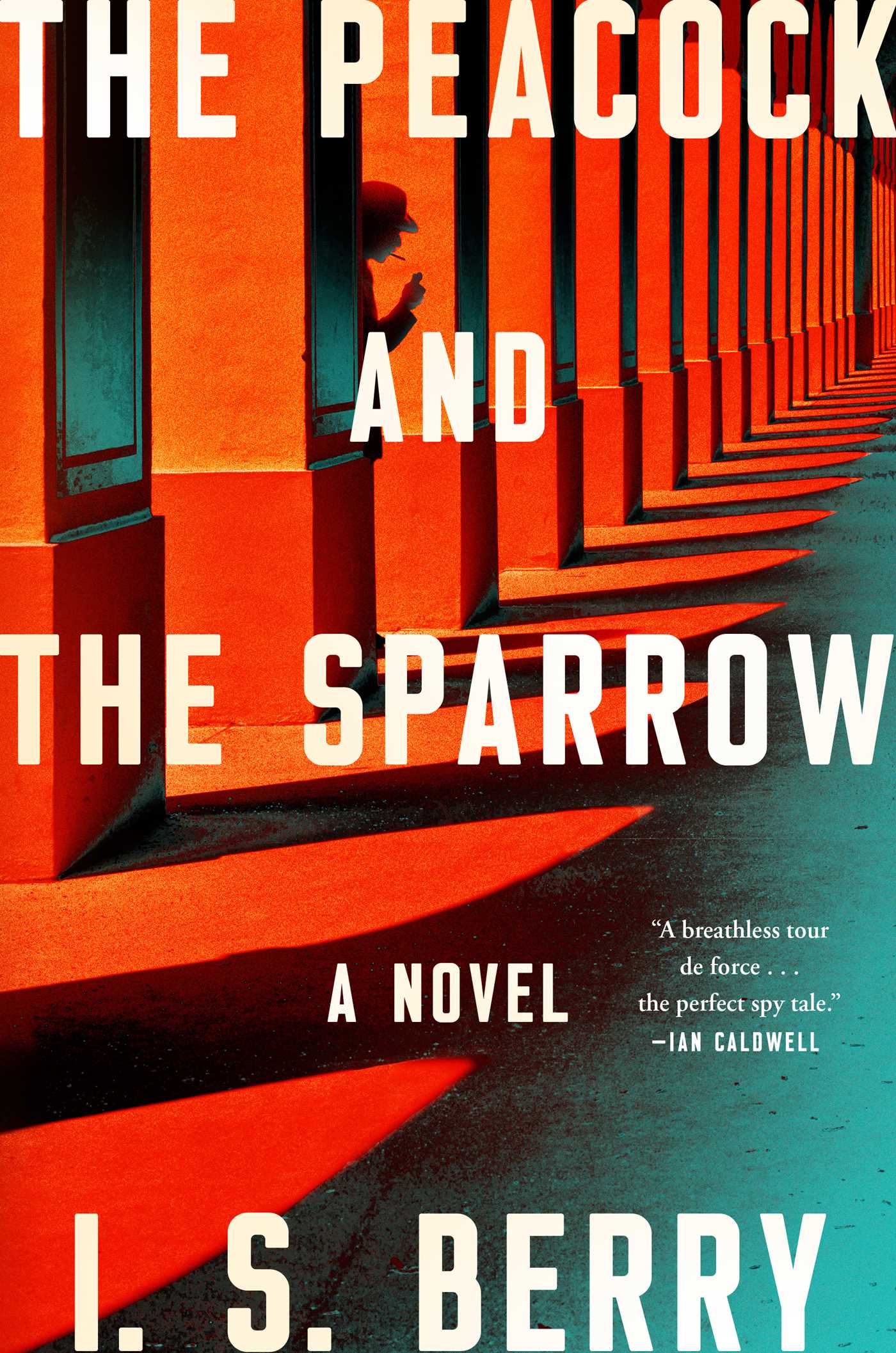
Publish Date: May 30, 2023
Genre: Crime, Suspense, Thrillers
Author: I.S. Berry
Page Count: 320 pages
Publisher: Atria
ISBN: 9781982194543












![Iron Maiden Legend Nicko McBrain Turned Down Trump Golf Invite: [He] Should Be Put in Jail](https://consequence.net/wp-content/uploads/2026/10/Nicko-McBrain.jpg "Iron Maiden Legend Nicko McBrain Turned Down Trump Golf Invite: [He] Should Be Put in Jail")